
A HAZCHEM code is an Emergency Action Code used on Australian dangerous-goods placards to help emergency responders choose incident-control measures.
Source check: 8 August 2026 · How this page is checked · Report a correction
Quick answer
HAZCHEM: A HAZCHEM code is an Emergency Action Code used on Australian dangerous-goods placards to help emergency responders choose incident-control measures.
When HAZCHEM helps
Use HAZCHEM when reading or reporting Australian dangerous-goods placards and planning for a chemical incident. A first aider should treat the code and placard as scene-safety and handover information: keep clear, call Triple Zero (000) for an emergency, and accurately relay the visible code, UN number and product information without trying to improvise a response.
Safety boundary: Do not improvise vomiting, neutralising chemicals or entry into an unsafe atmosphere; use 000 or the Poisons Information Centre as appropriate. If a real incident is unfolding, act on the person’s condition, call Triple Zero (000) when it is an emergency and follow the operator’s instructions.
Where it sits: HAZCHEM is commonly read alongside SDS, MSDS, CO, GHS, but each term has a different job. The comparisons later on this page explain those boundaries.
Framework status: HAZCHEM is the Australian name for an Emergency Action Code under ADG Code 7.9, not an expansion of ‘hazardous chemical’. Code interpretation is specialist response information; first aiders should keep clear and relay the visible details.
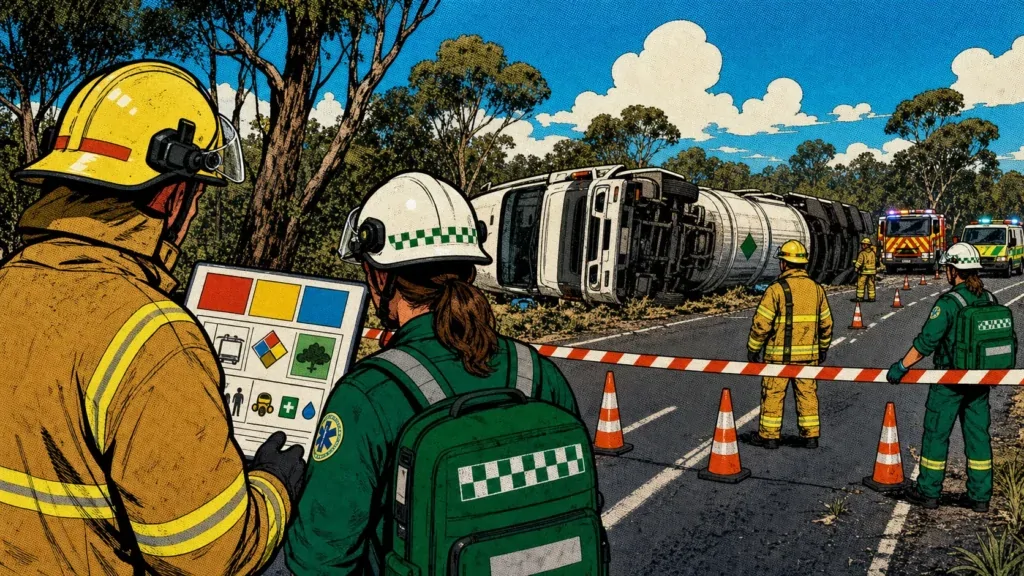
What Does HAZCHEM Mean?
| CODE | Emergency Action Code A compact number-and-letter code on relevant dangerous-goods placarding. It is response information for an incident, not an acronym expansion and not the chemical’s name. |
Common Mistakes
- Do not expand HAZCHEM as ‘hazardous chemical’; it is the name used for an Emergency Action Code.
- Do not use the code as permission to enter a spill, vapour or fire area without the required emergency-response training and controls.
- Do not assume the HAZCHEM code identifies the exact substance; relay the UN number, placard, label and SDS details as well.
HAZCHEM Step-By-Step For Beginners
Use this detailed sequence when learning how HAZCHEM applies to Australian dangerous-goods placards, Emergency Action Codes, scene safety and chemical-incident handover. It connects the letters to observable checks, clear words and a useful handover rather than treating the acronym as a bare list.
- Recognise what the code is. HAZCHEM is the name used for an Emergency Action Code under the Australian Dangerous Goods Code. It is not an acronym expansion of the words hazardous chemical.
- Treat the placard as response information. The code gives trained emergency responders compact incident-control information. A first aider should not attempt to decode it into an improvised chemical response.
- Keep people clear and call early. For a spill, vapour, fire or people becoming unwell near dangerous goods, keep yourself and bystanders away and call Triple Zero (000). Follow emergency service instructions.
- Read the placard accurately. From a safe position, report the visible HAZCHEM code, UN number, product name and location. Those details help emergency services identify the load and prepare the response.
- Use the label and SDS for exposure details. When it is safe and relevant, the product label and SDS provide substance-specific first aid information. For non-life-threatening poisoning advice, call 13 11 26.
A Real-World HAZCHEM Scenario
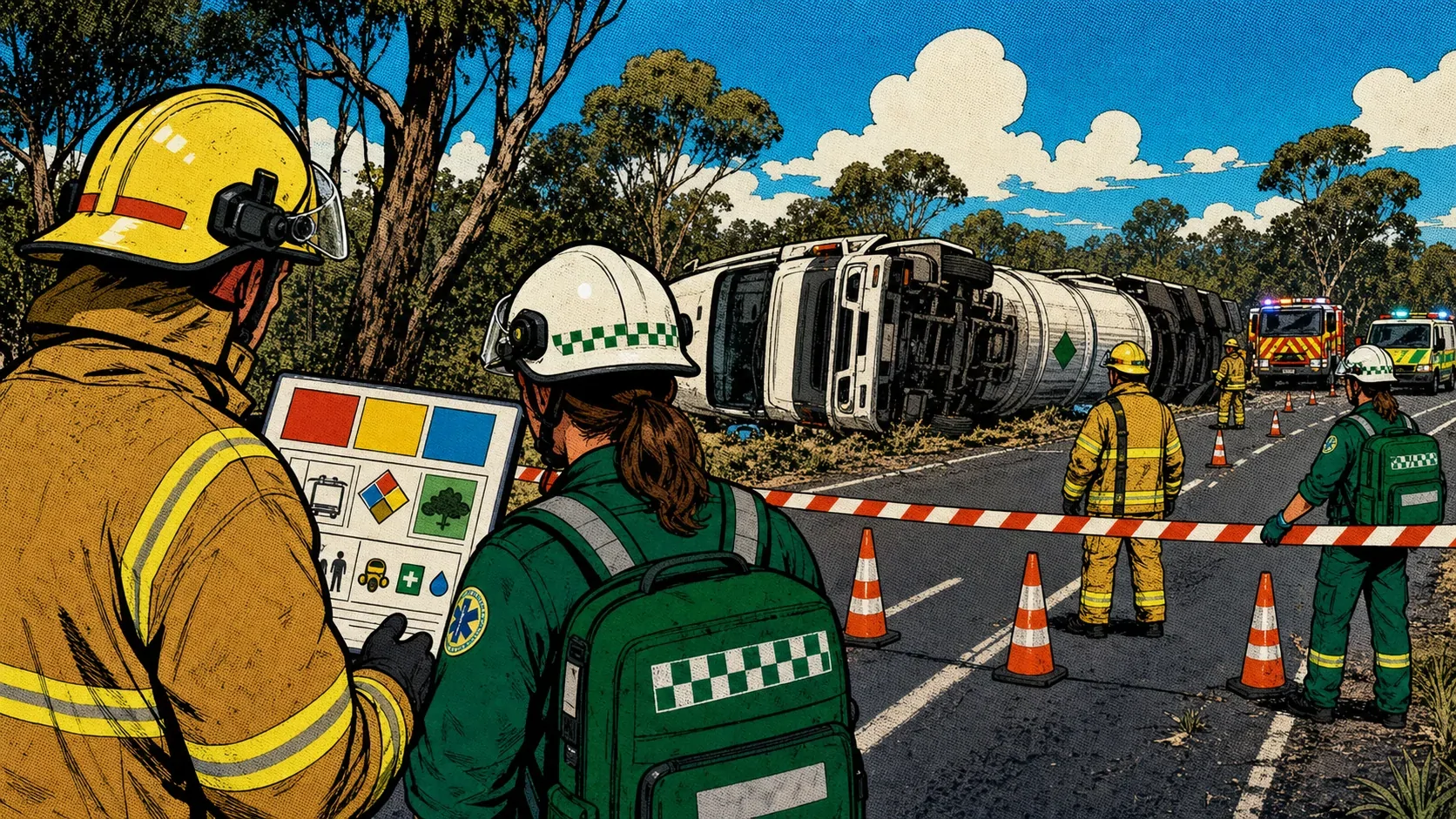
The scene: A damaged chemical container creates vapour and an unknown hazard near a loading area.
In this HAZCHEM scene, begin with CODE for Emergency Action Code: A compact number-and-letter code on relevant dangerous-goods placarding. It is response information for an incident, not an acronym expansion and not the chemical’s name. That opening prompt matters here because Use HAZCHEM when reading or reporting Australian dangerous-goods placards and planning for a chemical incident. A first aider should treat the code and placard as scene-safety and handover information: keep clear, call Triple Zero (000) for an emergency, and accurately relay the visible code, UN number and product information without trying to improvise a response. Keep the observation tied to Australian dangerous-goods placards, Emergency Action Codes, scene safety and chemical-incident handover; in practice, watch scene safety, the product or animal involved, route of exposure, symptoms, timing and whether other people are at risk rather than reciting the letters without checking the person or setting.
HAZCHEM names Emergency Action Code rather than offering a multi-step response. In this article it helps explain Australian dangerous-goods placards, Emergency Action Codes, scene safety and chemical-incident handover. A compact number-and-letter code on relevant dangerous-goods placarding. It is response information for an incident, not an acronym expansion and not the chemical’s name. Use that definition to make the handover more precise about the label or product name, quantity if known, exposure route, time, symptoms and first aid already attempted. Keep its limit visible as well: Do not expand HAZCHEM as ‘hazardous chemical’; it is the name used for an Emergency Action Code.
Where the scenario could change: Do not expand HAZCHEM as ‘hazardous chemical’; it is the name used for an Emergency Action Code. Do not improvise vomiting, neutralising chemicals or entry into an unsafe atmosphere; use 000 or the Poisons Information Centre as appropriate. If the facts no longer fit a stable HAZCHEM example, stop rehearsing the acronym and move to the safer emergency, clinical or workplace pathway.
HAZCHEM and similar terms
A code used by emergency services when responding to dangerous-goods incidents. It is not a set of instructions for an untrained bystander.
Here is how the related terms differ:
- SDS: A safety data sheet: a document with a chemical's hazards, first-aid information and handling instructions. Use the sheet for the actual product involved.
- MSDS: An older name for a material safety data sheet. You will usually see the newer name SDS on current chemical safety documents.
- CO: Carbon monoxide, a poisonous gas. This is the name of a hazard, not a first-aid action plan.
- GHS: The system behind chemical hazard labels and symbols. It helps explain a product's hazards; a safety data sheet gives more detail.
Frequently asked questions
What does HAZCHEM mean?
A HAZCHEM code is an Emergency Action Code used on Australian dangerous-goods placards to help emergency responders choose incident-control measures.
When is HAZCHEM useful?
Use HAZCHEM when reading or reporting Australian dangerous-goods placards and planning for a chemical incident. A first aider should treat the code and placard as scene-safety and handover information: keep clear, call Triple Zero (000) for an emergency, and accurately relay the visible code, UN number and product information without trying to improvise a response.
Is HAZCHEM an acronym for hazardous chemical?
No. In the Australian dangerous-goods context, HAZCHEM is the name used for an Emergency Action Code. The displayed numbers and letters carry response information.
Does a HAZCHEM code identify the exact chemical?
No. The placard’s UN number and other product or transport information identify the dangerous goods. Relay all visible details to emergency services.
Should a first aider act on the code?
Use it as scene-safety and handover information. Do not enter or attempt a specialist spill or fire response unless trained, equipped and authorised.
How is HAZCHEM different from SDS?
HAZCHEM is framed here around Australian dangerous-goods placards, Emergency Action Codes, scene safety and chemical-incident handover. SDS is framed around workplace chemical exposure, first aid rooms, hazardous substances and emergency handover. They may appear in the same course or incident, but they answer different questions and should not be treated as interchangeable.
When should I call Triple Zero (000)?
Call Triple Zero (000) when the person is seriously ill or injured, is deteriorating, or the urgent warning signs described on this page are present. Do not improvise vomiting, neutralising chemicals or entry into an unsafe atmosphere; use 000 or the Poisons Information Centre as appropriate.
Related Acronyms
- National Transport Commission ADG Code 7.9
- ADG Code 7.9 Appendix C HAZCHEM codes
- Safe Work Australia HAZCHEM placards
- Safe Work Australia hazardous chemicals
- Safe Work Australia GHS 7
This guide is educational and does not replace accredited first aid training, professional medical advice, or directions from emergency services.