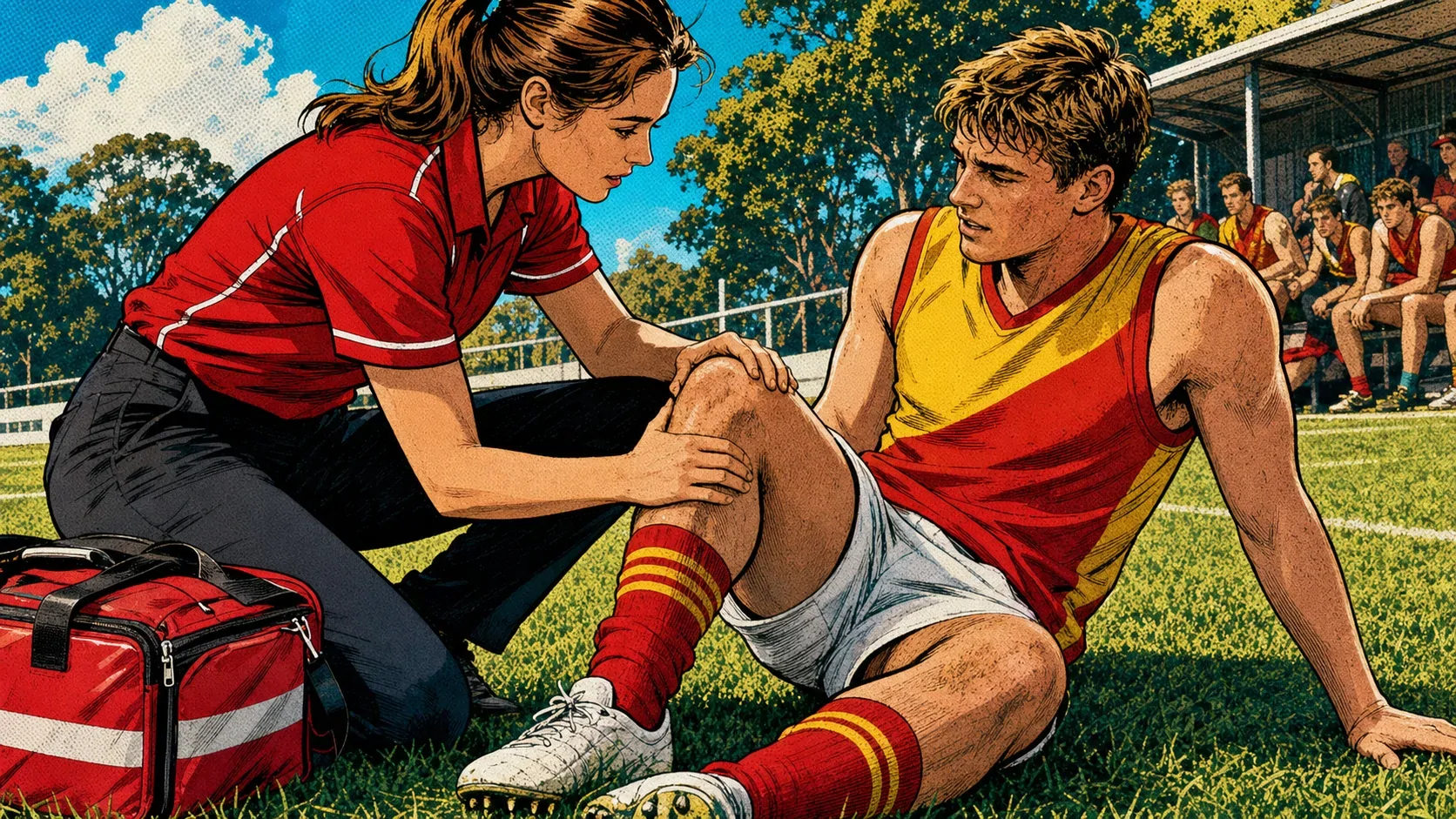

TOTAPS helps first aiders assess a sporting injury in a calm, step-by-step way.
Source check: 8 August 2026 · How this page is checked · Report a correction
Quick answer
TOTAPS: T means Talk; O means Observe; T means Touch; A means Active movement; P means Passive movement; S means Skills test. TOTAPS helps first aiders assess a sporting injury in a calm, step-by-step way.
When TOTAPS helps
Use TOTAPS for on-field or courtside decisions after DRSABCD and urgent injuries have been excluded. Stop the assessment and escalate for medical help if you see deformity, severe pain, suspected fracture/dislocation, numbness/tingling, poor circulation, inability to weight bear, or any concussion/head injury concern. When in doubt, sit them out and arrange assessment.
Safety boundary: An injury acronym comes after danger and life threats; suspected fracture, dislocation, head injury or severe bleeding needs escalation. If a real incident is unfolding, act on the person’s condition, call Triple Zero (000) when it is an emergency and follow the operator’s instructions.
Where it sits: TOTAPS is commonly read alongside NO HARM, PEACE & LOVE, POLICE, PRICE, but each term has a different job. The comparisons later on this page explain those boundaries.
Framework status: TOTAPS is a sports-side teaching and screening aid, not a validated diagnosis or medical clearance tool. Any concerning finding ends the check and moves the person to appropriate assessment.
What Does TOTAPS Stand For?
| T | Talk Ask what happened, where it hurts and what they felt. |
| O | Observe Look for swelling, deformity, bleeding, guarding or distress. |
| T | Touch Gently feel around the area if appropriate. |
| A | Active movement Ask the person to move the part themselves if safe. |
| P | Passive movement Only if appropriate, carefully move the part through range. |
| S | Skills test Return to sport only if sport-specific movement is pain free and safe. |
Common Mistakes
- Do not use TOTAPS on an unconscious, confused or severely injured person.
- Do not test skills if walking, grip or simple movement is painful.
- Do not treat concussion as a ‘play on’ decision.
TOTAPS Step-By-Step For Beginners
Use this detailed sequence when learning how TOTAPS applies to sideline sport injury checks after danger and life threats are ruled out. It connects the letters to observable checks, clear words and a useful handover rather than treating the acronym as a bare list.
- Before: Safety and serious injury check. TOTAPS is a sideline screen, not a diagnosis. It’s most useful for a straightforward knock or twist where you’re deciding whether the person can safely continue, or needs to stop and be assessed (for example, a rolled ankle, a knee that “gave way”, or a shoulder bump). If there is deformity, severe pain, suspected fracture/dislocation, numbness/tingling, poor circulation, inability to bear weight, or any concussion concern, stop and escalate for assessment. If you think an ambulance is needed, call Triple Zero (000).
- T – Talk. Ask what happened, where it hurts, and whether they felt a pop, crack, giving way, or dizziness.
- O – Observe. Look for swelling, deformity, bruising, bleeding, guarding, or distress. Compare to the uninjured side when appropriate.
- T – Touch. Gently feel around the area if it is safe and appropriate. Stop if there is severe pain or obvious deformity.
- A – Active movement. Ask them to move it themselves if safe. Pain, weakness, or inability to move normally is a stop signal.
- P – Passive movement. Only if appropriate: carefully move through range. If unsure, skip this and refer rather than forcing a test.
- S – Skills test. Return to play only if sport-specific movement is pain free, stable, and confident. If in doubt, sit them out.
A Real-World TOTAPS Scenario
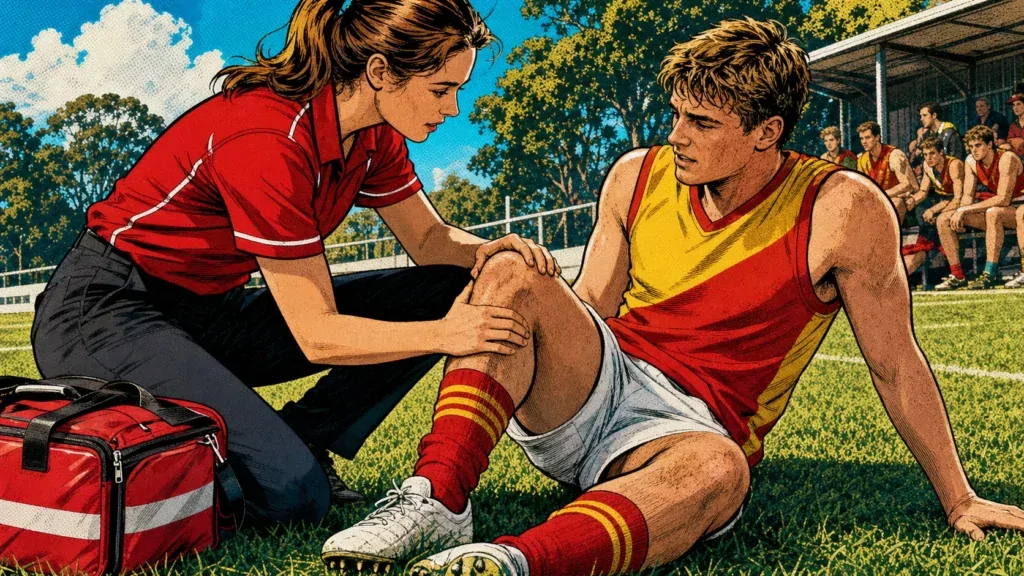
The scene: A sideline first aider assesses a player after a collision before any return-to-play discussion.
In this TOTAPS scene, begin with T for Talk: Ask what happened, where it hurts and what they felt. That opening prompt matters here because Use TOTAPS for on-field or courtside decisions after DRSABCD and urgent injuries have been excluded. Stop the assessment and escalate for medical help if you see deformity, severe pain, suspected fracture/dislocation, numbness/tingling, poor circulation, inability to weight bear, or any concussion/head injury concern. When in doubt, sit them out and arrange assessment. Keep the observation tied to sideline sport injury checks after danger and life threats are ruled out; in practice, watch the mechanism, deformity, circulation, sensation, function and any signs that the problem is more than a minor injury rather than reciting the letters without checking the person or setting.
For TOTAPS, S closes the pattern as Skills test. Return to sport only if sport-specific movement is pain free and safe. Before the sequence is treated as complete, relate it to how the injury happened, where it hurts, what changed, what care was given and whether function or circulation deteriorated. A specific trap to avoid is: Do not treat concussion as a ‘play on’ decision.
Where the scenario could change: Do not use TOTAPS on an unconscious, confused or severely injured person. An injury acronym comes after danger and life threats; suspected fracture, dislocation, head injury or severe bleeding needs escalation. If the facts no longer fit a stable TOTAPS example, stop rehearsing the acronym and move to the safer emergency, clinical or workplace pathway.
TOTAPS and similar terms
A sports-injury check used by trained sports responders after urgent dangers have been ruled out. It helps assess an injury; it is not a recovery programme or a guarantee that returning to play is safe.
Here is how the related terms differ:
- NO HARM: A reminder of things to avoid after a soft-tissue injury. It focuses on avoiding further harm, rather than assessing whether someone can return to sport.
- PEACE & LOVE: A way of talking about early soft-tissue injury care and later recovery. The later exercise steps belong in a recovery plan, with professional advice where needed.
- POLICE: An injury-care memory aid that includes protecting the injury and gradually using it as appropriate. It is often discussed in rehabilitation, rather than as an emergency response.
- PRICE: An injury-care memory aid for protection, rest, ice, compression and elevation. It concerns soft-tissue injuries, after urgent problems have been ruled out.
Frequently asked questions
What does TOTAPS stand for?
T means Talk; O means Observe; T means Touch; A means Active movement; P means Passive movement; S means Skills test. TOTAPS helps first aiders assess a sporting injury in a calm, step-by-step way.
When is TOTAPS useful?
Use TOTAPS for on-field or courtside decisions after DRSABCD and urgent injuries have been excluded. Stop the assessment and escalate for medical help if you see deformity, severe pain, suspected fracture/dislocation, numbness/tingling, poor circulation, inability to weight bear, or any concussion/head injury concern. When in doubt, sit them out and arrange assessment.
What is TOTAPS actually for?
It’s a quick structured check to guide a sideline decision: can they safely continue basic movement, or should they stop and be assessed? It helps you notice obvious problems; it does not diagnose hidden injuries.
What counts as a ‘skills test’?
It means the sport-specific movement needed to play (for example: jogging, change of direction, jumping/landing) done pain free, stable, and confident. Start gentle and stop immediately if pain, instability, dizziness, or lack of confidence appears.
When should I stop TOTAPS and escalate?
Stop and get medical help for deformity, severe pain, suspected fracture/dislocation, numbness/tingling, poor circulation, inability to bear weight, or any concussion concern.
How is TOTAPS different from NO HARM?
TOTAPS is framed here around sideline sport injury checks after danger and life threats are ruled out. NO HARM is framed around the first 48 to 72 hours after a soft-tissue injury. They may appear in the same course or incident, but they answer different questions and should not be treated as interchangeable.
When should I call Triple Zero (000)?
Call Triple Zero (000) when the person is seriously ill or injured, is deteriorating, or the urgent warning signs described on this page are present. An injury acronym comes after danger and life threats; suspected fracture, dislocation, head injury or severe bleeding needs escalation.
Related Acronyms
- Sports Medicine Australia resources
- Sports Medicine Australia soft tissue injuries
- healthdirect concussion
This guide is educational and does not replace accredited first aid training, professional medical advice, or directions from emergency services.